Creatine monohydrate helps replenish the rapid-energy system athletes use during short, high-intensity efforts. When combined with appropriate training, it can support strength, power, repeated-effort capacity, and gains in lean body mass. A consistent 3–5 g daily maintenance dose is commonly studied; it supports training but does not replace coaching, sleep, food, hydration, or recovery.
Disclosure: Atlee Mahorn has an endorsement relationship with LivFit Sports & Nutrition. This article includes general education, not individualized medical or nutrition advice. Product certification and lot status should always be verified directly through the certifier before use.
In an Olympic sprint, the difference between advancing and going home can live inside fractions of a second. But the lesson I carried from elite sprinting into coaching is bigger than any supplement: performance comes from a system. Technique, force production, intelligent programming, nutrition, sleep, and consistency must work together.
Creatine monohydrate can be a useful part of that system. It is also one of the most misunderstood products in sports nutrition. Some athletes expect an instant speed boost. Others avoid it because of myths about water, kidneys, or “bulking.” The useful answer sits between the hype and the fear.
What Creatine Actually Does
Your muscles use adenosine triphosphate—ATP—as immediate energy. During a maximal sprint, jump, throw, or heavy lift, ATP is spent quickly. Stored phosphocreatine helps rebuild ATP so high-intensity work can continue or be repeated.
Supplementing with creatine monohydrate can increase muscle creatine stores. That does not mean every athlete immediately runs faster. It means the athlete may have greater capacity to produce and repeat quality work, particularly when training and recovery are already well designed.
Four Ways Creatine Can Support Training
1. Strength
Creatine does not replace progressive resistance training. Its value is that it can support the athlete's ability to complete high-quality work over time. Better training capacity can contribute to greater strength adaptation when the program, technique, and recovery are appropriate.
2. Power
Sprinting, jumping, Olympic lifting, and explosive changes of direction require force to be produced quickly. Creatine is relevant because those actions rely heavily on rapid energy availability. The practical goal is not to “feel” creatine working; it is to support repeated exposures to high-quality power training.
3. Repeat-Effort Performance
A single sprint matters, but most field and court athletes must accelerate again and again. Football, soccer, basketball, hockey, and lacrosse repeatedly tax the ability to recover between intense efforts. Creatine may be particularly useful when training involves repeated sprints, sets, jumps, or lifts with limited recovery.
4. Lean Body Mass
When creatine is combined with resistance training, research supports its role in gains in lean body mass. Some early scale change can reflect additional water stored inside muscle. That is not the same as gaining body fat, and it does not guarantee new contractile muscle tissue without effective training.
Why 5 Grams?
Research and position stands commonly describe 3–5 grams per day as a maintenance range for many healthy adults once muscle creatine stores are saturated. Larger athletes may sometimes use more under qualified guidance. The best amount is not automatically the biggest amount.
| Approach | What It Means | Coaching Perspective |
|---|---|---|
| Steady daily use | A consistent lower daily dose gradually raises muscle stores. | Simple, sustainable, and easier to fit into a routine. |
| Loading phase | Several smaller doses per day for a short period saturate stores faster. | Optional—not required for long-term benefit. |
| Maintenance | A regular daily dose helps maintain elevated stores. | Consistency matters more than an elaborate schedule. |
Timing is usually less important than adherence. Athletes often take creatine with a meal or around training because that makes it easy to remember. If a powder, capsule, or gummy format helps an athlete follow an appropriate plan, convenience has value—but the ingredient, dose, label, and exact product verification still matter.
Will Creatine Make You Faster?
Creatine is not sprint technique in a container. It cannot fix poor posture, overstriding, weak acceleration angles, insufficient strength, or a badly organized training week. A sprinter becomes faster by adapting to precise, progressive work.
Creatine may support that process by helping the athlete tolerate or repeat quality strength and power efforts. Any speed benefit is therefore usually indirect and training-dependent. The supplement supports the work; it does not replace the work.
- Acceleration: still requires horizontal force, projection, and technical practice.
- Maximum velocity: still requires posture, front-side mechanics, stiffness, rhythm, and exposure to high speed.
- Power: still requires progressive strength, ballistic intent, and adequate recovery.
- Repeat sprint ability: still requires conditioning designed for the athlete's sport and position.
For the training side of the equation, read Force-Velocity Profiling: Find Every Athlete's Deficit and The NFL Offseason Strength Blueprint.
What NSF Certified for Sport Means
Competitive athletes face a special problem: under strict-liability anti-doping rules, the athlete is responsible for prohibited substances found in the body—even if contamination was accidental. Supplements are not guaranteed risk-free.
NSF Certified for Sport is designed to reduce that risk. The program includes testing for prohibited substances, formulation and label review, facility inspections, and product verification. USADA recommends that athletes who choose to use supplements select products certified by a third-party program that tests for substances prohibited in sport and identifies NSF Certified for Sport as best suited to reduce supplement risk.
A graphic, website badge, brand name, or prior certification is not enough. Certification may apply only to particular products or lots. Search the official database for the product and batch number, and recheck when purchasing a new container.
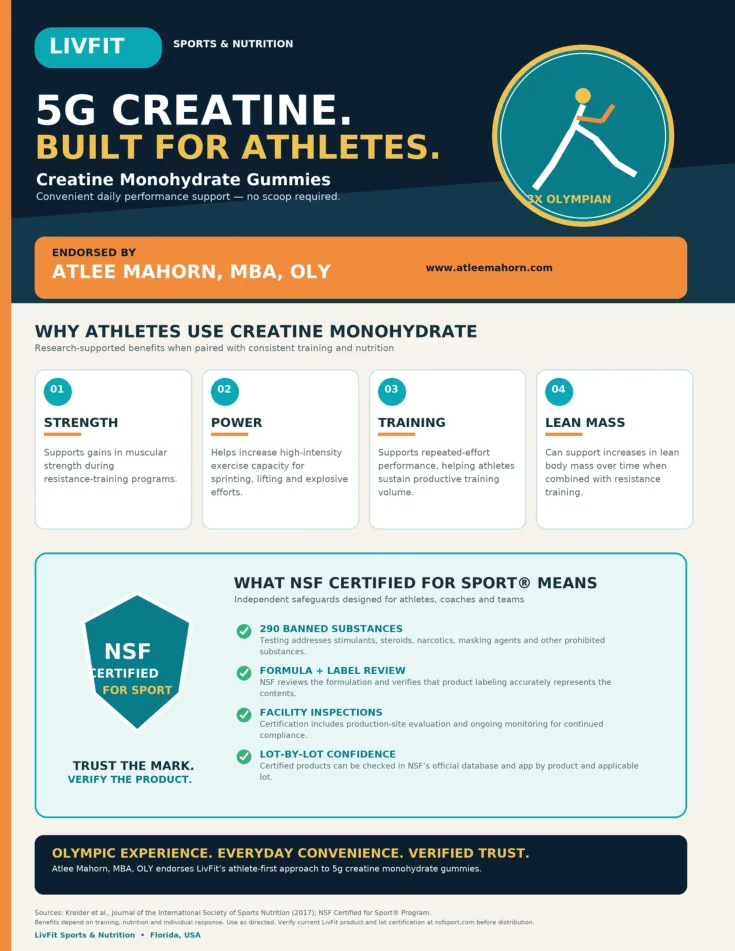
The source infographic supplied for this article. Verify current ingredients, directions, and the exact product and lot certification before use.
Who Should Ask Before Using Creatine?
General evidence about creatine is not a personal green light. Athletes should discuss supplementation with a qualified sports dietitian, physician, or other appropriate healthcare professional when they are under 18, pregnant or nursing, have kidney or other medical conditions, take medications, are managing weight-class demands, or are subject to team, school, federation, or anti-doping policies.
Youth athletes need special care. Their first priorities should be sufficient food, hydration, sleep, supervised training, and age-appropriate development. Coaches should never pressure a minor to use a supplement or treat supplementation as a shortcut to playing time.
A Coach's Creatine Checklist
- Start with food and training: correct the program, sleep, fueling, and hydration before adding complexity.
- Choose creatine monohydrate: it is the form with the deepest research history.
- Check the full serving: confirm the amount delivered by the actual number of gummies, scoops, capsules, or packets.
- Verify the product and lot: use the official third-party database—not only packaging artwork.
- Review other ingredients: gummies and flavored products may contain sweeteners, allergens, or additional compounds.
- Use qualified guidance: especially for minors, medical conditions, medication use, and tested athletes.
- Track the right outcomes: training quality, body mass, tolerance, recovery, and sport performance—not hype.
The Bottom Line
Creatine monohydrate is one of the best-supported sports supplements for high-intensity exercise capacity and training adaptation. A convenient 5 g serving can fit a simple daily routine for many adult athletes. But no gummy, powder, or capsule builds an athlete on its own.
The real performance formula remains the same one I learned through Olympic preparation: quality coaching, specific training, disciplined recovery, adequate nutrition, and consistency. Creatine can support that system. It should never distract from it.
Frequently Asked Questions
What does creatine do for athletes?
Creatine increases available muscle creatine and phosphocreatine stores, helping regenerate ATP during short, high-intensity efforts. Combined with training, it can support strength, power, repeated-effort capacity, and lean body mass.
Is 5 grams of creatine a day enough?
For many healthy adults, 3–5 g per day is a commonly studied maintenance range after stores are saturated. Individual needs differ, and medical or sport-specific circumstances should be reviewed with a qualified professional.
Do athletes have to load creatine?
No. Loading can raise muscle stores faster, but a consistent lower daily dose can reach saturation more gradually. Long-term consistency is more important than an unnecessarily complicated schedule.
Does NSF Certified for Sport make a supplement risk-free?
No. Third-party certification reduces risk; it cannot eliminate it. Verify the exact product and lot through NSF's official database and follow the athlete's governing-body and medical guidance.
Sources & Further Reading
Kreider, R.B. et al. “International Society of Sports Nutrition position stand: safety and efficacy of creatine supplementation in exercise, sport, and medicine.” Journal of the International Society of Sports Nutrition, 2017.
Full text.
NSF, Certified for Sport program and product verification.
U.S. Anti-Doping Agency, “Always Verify Third-Party Certified Logos on Supplements.”